
How We Talk Shows Kids How to Think: The Power of Conversational Modeling

When I was little I spent a lot of time listening to people talk - not at me, necessarily, but over or around me. I was allowed in on many different kinds of adult conversations: listening to my parents have professional conversations with clients, social ones with friends and family, intellectual ones about things they were thinking about or reading.
It helped that my parents were people without a lot of social etiquette or boundaries; they didn’t ascribe any significance to ideas like adults and children sitting separately at meals, or having children play in a designated playroom in our house.
It also helped that the kind of people my parents had over, usually drawn from the surrounding university community, were also very willing to engage in analytical, introspective or wide-ranging exploratory conversations about just about anything. Politics, social issues, literature, history, art, film.
I have clear memories of sitting under the dining table and playing with people’s feet while listening to people above ground debate the merits of various editions of the Iliad, discuss maths theorems they were working on, explain books they were reading, or pose questions about new projects or areas of interest they were just beginning to explore and needed help understanding.
Most importantly, these conversations taught me how to think.
I heard people analyze, dissect, expound, compare, describe, enquire, clarify, grandstand. I heard them parry, parse, consider, turn over, reject, accept, and build on each other’s ideas. These conversations were not about outcomes. They were about exploration.
Why Modeling Live Conversations Matters in a Screen-Filled World
Now - in an era where phones are insistently pleading for our passive attention and where texting is often an easier alternative to real-time interactions - modeling live, verbal conversations for our children is more important than ever, for social-emotional development as well as for teaching critical thinking.
Even when it seems like our children are not paying attention to our in-person conversations, they are picking up meaningful social and critical thinking cues about how to handle or approach situations, how to navigate a new topic, or how to handle uncertainty. The voices they hear while they’re young - voices that analyze, dissect, enquire, clarify - are also ones they will eventually, over time, internalize as they cultivate their own critical thinking and social skills.
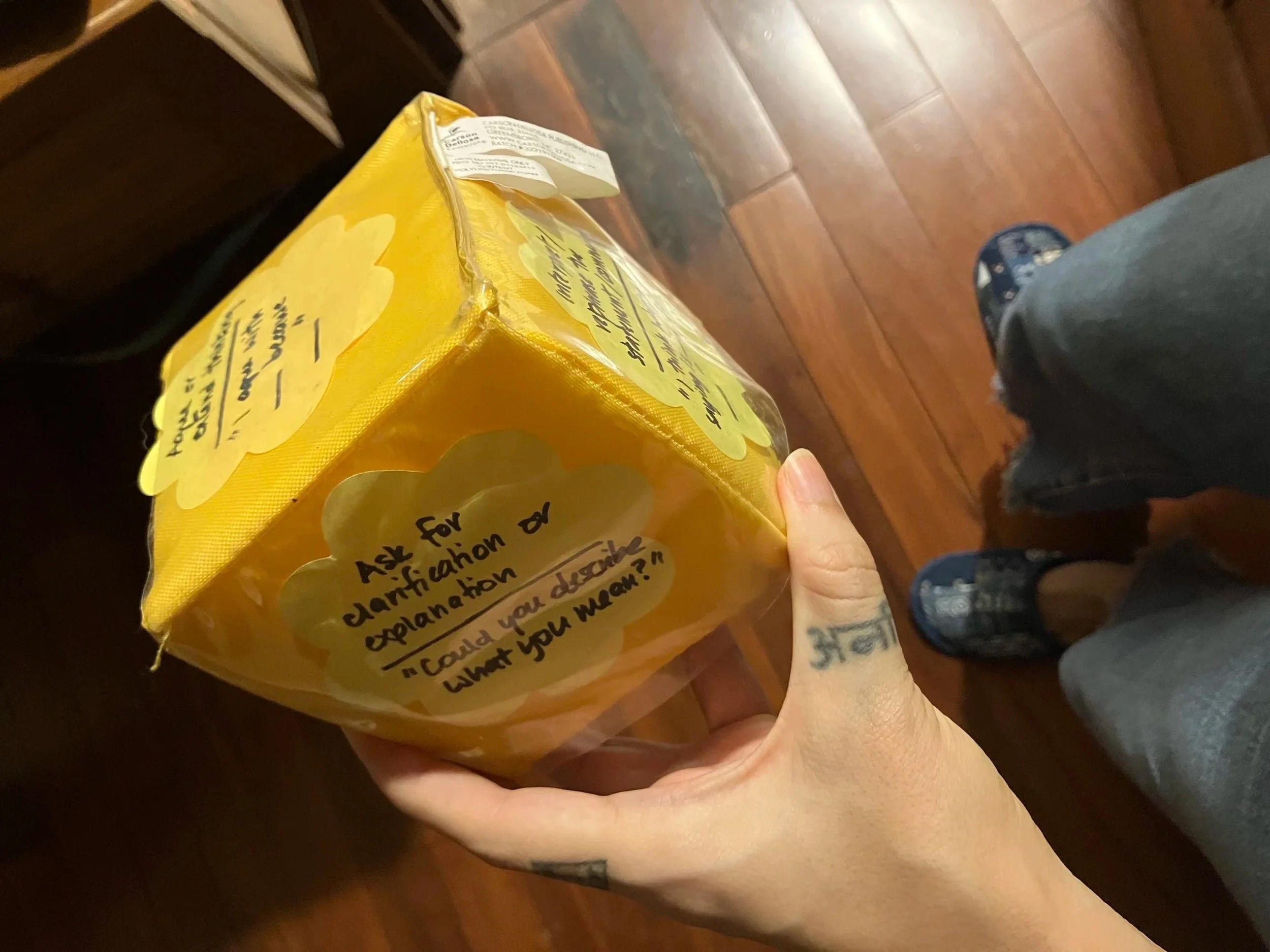
A soft, conversational cube (like this homemade one) can help show children how many different ways there are to respond to another person’s comment or observation, and offer examples of what to say to build critical thinking skills.
Helping Children Shift from Performance to Active Critical Thinking
Often, when I teach critical thinking skills in classrooms in Asia, there are children who are not raised in households where conversation (or children’s participation) are encouraged. These children often look alarmed when I tell them to have a conversation - this is different than the performance and outcome-based culture they’re familiar with.
The ideas and opinions are in there, I know; they just need some help jumpstarting the engine and gaining confidence in their conversational abilities.
One of my techniques is to throw things at them.
As it turns out, having a colorful, soft object vaulting at random in a classroom setting not only wakes you up, it also shows children the wandering, discursive nature of how a conversation can evolve: one observation could come from a child in the back corner, before they pass the object to a peer near the fish tank, followed by a pass to a student near the front of the room. If students need help thinking of what to say during their turn, they can look down at the object that they’re throwing around: it’s a soft cube with 6 sides, each side with an example of a kind of remark they could make to further the conversation and develop the discussion as a group.
This is fairly similar to how a real, organic conversation would go, and helps students who are not used to a back-and-forth of discussion begin to understand the diverse array of options for their participation. Most importantly, by providing multiple choices of how to respond in an exploratory way to another person’s comment, it highlights to them how it’s okay not to have the right answer, and how a conversation can ebb and flow.

A beach ball is also an easy, low-cost way to make your own “conversational cube”.
Practical Conversation Prompts: What to Write on Your Conversational Cube (or Beach Ball)
You can use any soft object as long as you can tape some post-it notes onto it and it won’t cause injury if a student isn’t a good catcher. I found my soft yellow cube (see the photo above) in a toddler’s play set at Salvation Army. The easiest and most universal object is probably a beach ball.
Once you find a suitable soft ball or play cube, here are the things you can write on (or tape to) your new “conversational cube” for a group of students:
Primary School Age (4-8 years)
Ask a Question: “Can you tell me more about that?”
Shout-Out: “That’s a great point because ___.”
Friendly Pushback: “I actually think ___, because ___.”
Connect the Dots: “That makes me think of ___.”
Say It Back: “It sounds like you mean ___, is that right?”
Build On It: “Yes, and another cool idea is ___.”
Middle School Age (8-13 years)
Ask to learn more: “Can you explain what you mean by that?”
Give a compliment: “I really liked your idea because ___.”
Respectfully disagree: “I see it a little differently because ___.”
Make a connection: “What you said reminds me of ___.”
Check if you understood: “So, are you saying that ___?”
Add to an idea: “I agree with you, and also ___.”
High School Age (13+ years)
Ask for clarification or explanation: “Could you describe what you mean?”
Affirm effort of the other person and recognise the value of their input: “I really like that you ____ because ___.”
Challenge or disagree: “I disagree with your point that ___ because ____.”
Synthesise or compare: “What you said about ___reminds me of ___” or “seems similar /makes me think of ____”
Interpret / rephrase the statement or comment: “I think what you’re saying is ____, so ____”
Agree or extend their thinking: “I agree with ___ because ___, and additionally _____.”