
Bridging Hong Kong’s AI Literacy Gap: Why Parent Education Matters in the Digital Age
Hong Kong’s AI Curriculum is Leaving Parents Behind, But Better Home-School Partnerships Can Fix It

This is an opinion piece contributed by Caroline, a Kigumi Summer Associate in Hong Kong and undergraduate pursuing her degree in interaction design and UX/UI.
The Hong Kong Education Bureau (EDB) recently released a blueprint that makes AI a crucial part of daily school life, which at first seems like a huge change for fundamental education.
However, after I listened to the panel discussion “Preparing Families for an AI-Driven Future” at the Parents’ Summit at Learning Teaching Expo (LTE 2026) last month in Hong Kong, I think there is a major challenge for the EDB’s AI policy: there is a huge gap in AI knowledge between schools and parents. The current AI in education blueprint focuses on how to support school sides and students to adopt AI, but it does not really focus on the parents’ side.
The Reality of Student AI Use
Beyond Homework: How Teenagers Are Actually Using AI Every Day
Data shows that Hong Kong teenagers spend over 5 hours online every day, in addition to 15% of young children who heavily use social media platforms and generative AI.
Many parents underestimate how much time their children spend on screens, and they often assume children are simply having fun on games or internet. But in reality, students are actually using AI for much more than finishing their homework or creating artworks. I often see people sharing different AI prompts on social media. Some use AI to act as their mental health therapist, while others let AI play different roles and converse with them.
Even I, out of curiosity, have tried different AI prompts to confide my troubles. After all, no one will be hurt by my words, and I can say whatever I want. Some students treat AI as a friend or an emotional companion to talk with. This brings up real psychological risks, which requires teachers and counsellors to step in and help.
Addressing Parent Resistance & Misconceptions
Plagiarism or Productivity? Overcoming Fear and Resistance to AI Tools
The majority of parents are resisting AI because of a one-sided understanding: for instance, they criticize any of AI-assisted artwork in school competition, characterising it as plagiarism and a cheating problem. The limitations of their thinking and horizons ignore the fact that AI is merely a creative tool that helps student to create different styles artworks even in the same platform, and the final product completely depends on students’ imagination and their capability to compose prompts.
Additionally, it cannot be denied that refusing to have knowledge of AI is not a helpful mindset to have in order to protect children. Instead, it makes it difficult for the whole family to adapt to the various markets that may be dominated by AI in the future. Just like in daily life, the penetration rate of AI in employment is actually higher than we imagine; we already probably reply to our bosses’s messages with AI, ask AI for travel guides, and have AI generate test papers for students. Parents should be prepared to guide their children to use AI properly, rather than to ban everything related to AI.
There is also another ethical issue: since some parents are completely lacking digital knowledge, they might not even realize how their children are relating with AI. To keep appropriate monitoring on their children’s behavior online, parents have to learn to overcome their fears toward AI, and to establish basic concepts and values about AI.
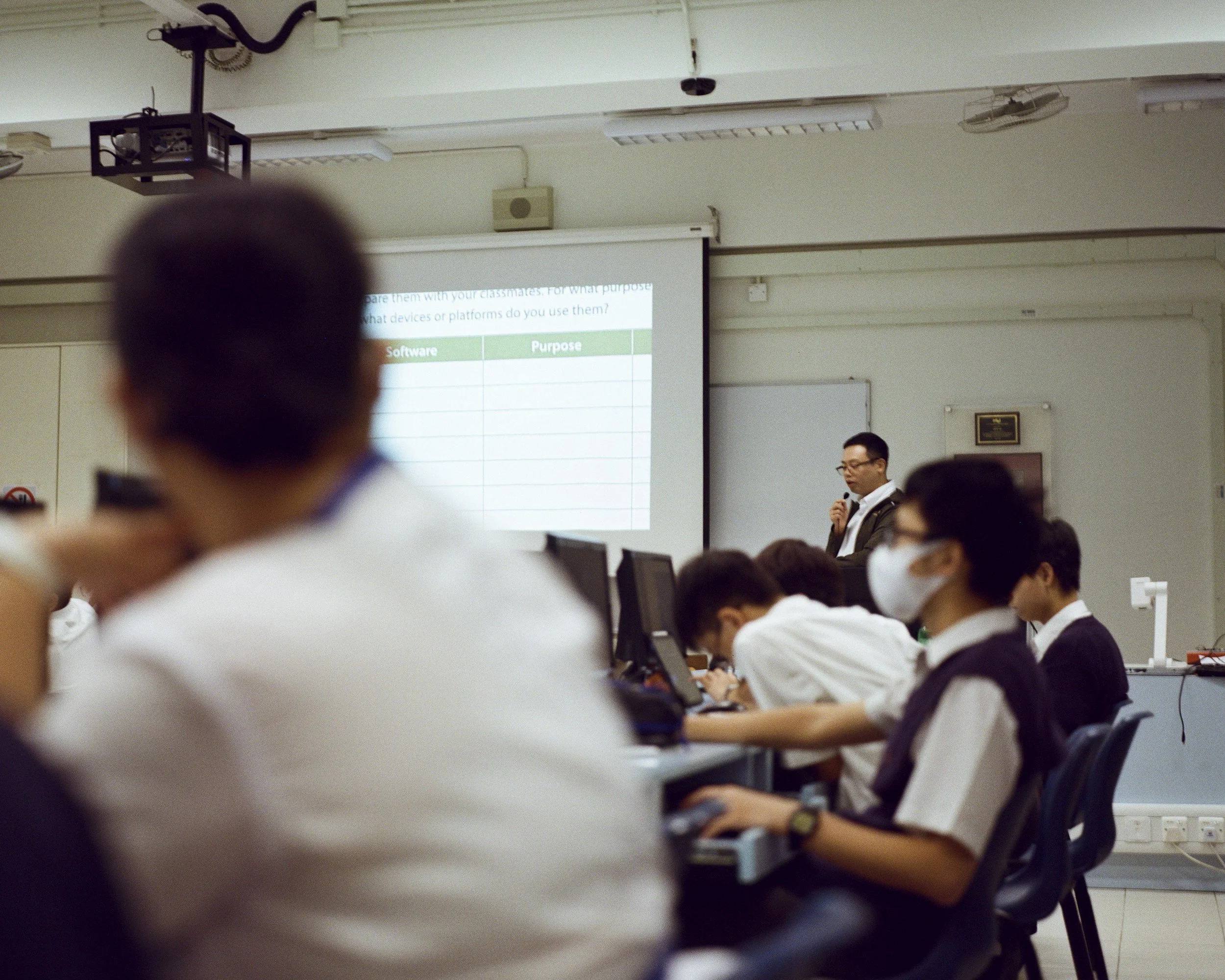
The Hong Kong government requires teachers to attend 30 hours of AI training, but there is no free training of the same scale was established for parents. Even at the talk, only a few parents there heard of one of the strategies shared and implemented in some Hong Kong schools: the “red-yellow-green” approach. In this approach, AI tools listed on the red list are prohibited for student use, the ones on the yellow list are allowed for use but with frequent adult monitoring, and the ones on the green list are encouraged for classroom use. While few parents were aware of these lists, these are already in use amongst some public school students and teachers in Hong Kong. This is one example that reflects the gap between teacher and parental knowledge about AI use by children.

Bridging the Gap Through School-Parent Collaboration
The Information Asymmetry: Why Parents Need Equal AI Training
According to the talk, public schools in Hong Kong have promoted several set of efficient AI teaching tools, for example, interactive math games and automated learning analysis systems. In my opinion, these tools actually do have the potential to help students by enabling personalized teaching and targeted remediation, but they will be wasted without improved communication between schools and parents.
In my perspective, in an AI-driven era, Hong Kong's education system requires closer home-to-school connections. This can be accomplished, for example, by increasing support and communication between the two sides, to fully realize the benefits of AI in education while protecting underage students from over-reliance on AI. To this end, all parties should assist parents in bridging the information gap regarding AI. For instance, offering free AI literacy workshops specifically for parents can equip them with AI knowledge; schools can also regularly distribute AI teaching materials to parents to eliminate information asymmetry.